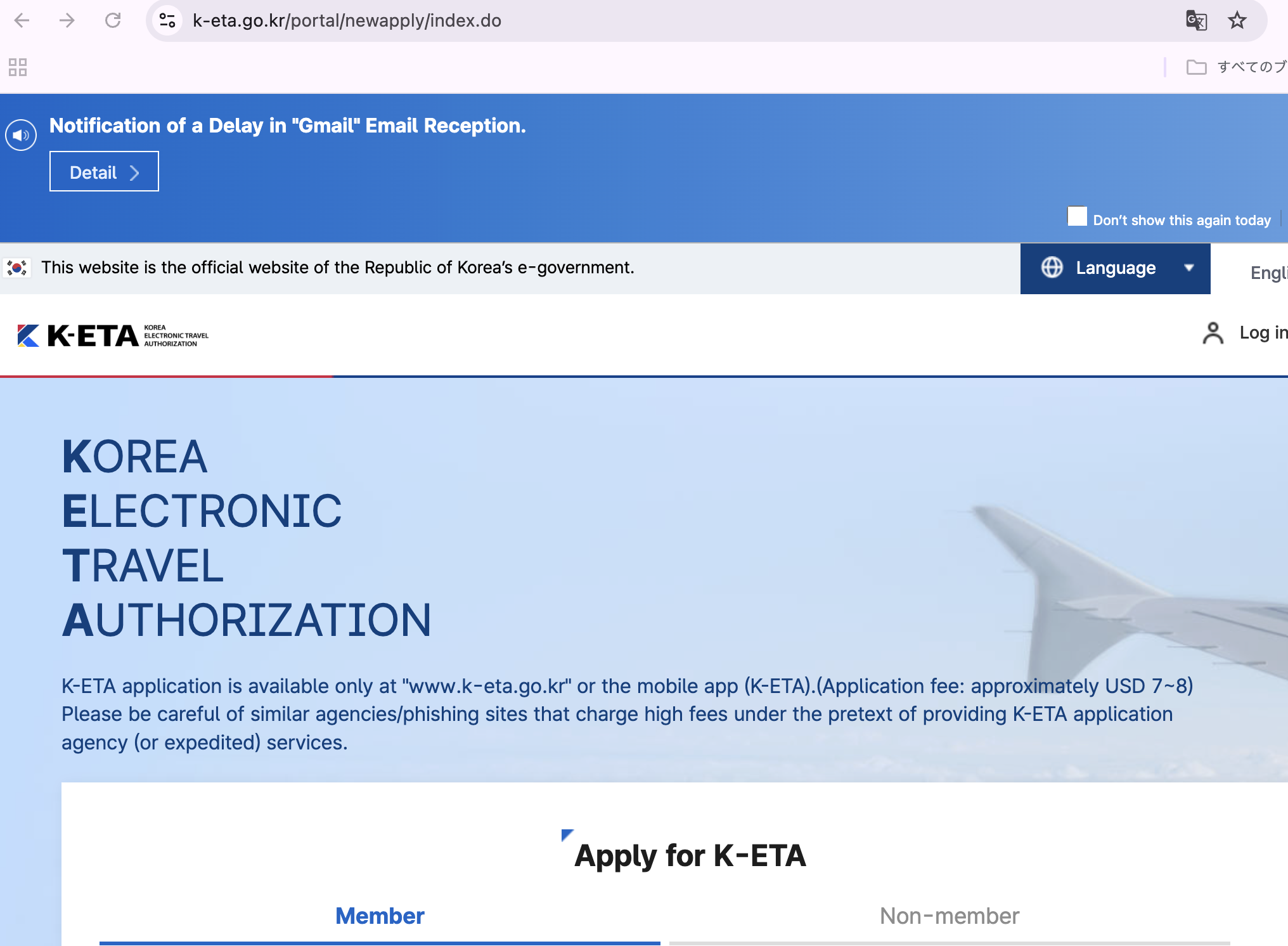
Here is a mistake that is easy to make at Incheon Airport. You have a connecting flight at Gimpo Airport, you have heard that “A’REX is the airport train,” and you walk toward the bright orange gates of the A’REX Express. Do not. The orange Express train does not stop at Gimpo. The orange runs nonstop between Incheon and Seoul Station, and tickets are not even sold for shorter rides. For Incheon to Gimpo, your train is the blue one: the A’REX All-Stop Train.
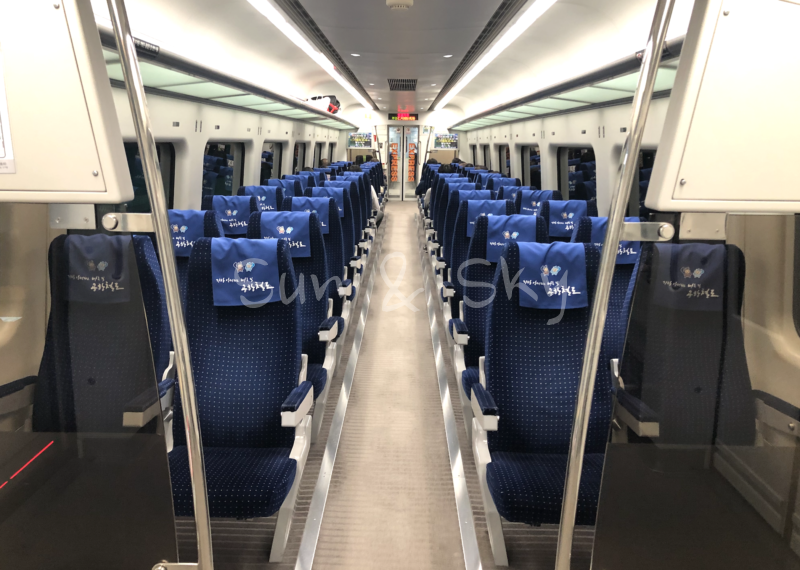
(Orange, taken in 2019)
The two trains share one line and one name, but they are different vehicles doing different jobs. Part of the confusion is built into the name itself: A’REX stands for Airport Railroad Express, which sounds like it should mean only the fast, nonstop train. In practice it is the name of the whole line and the company that runs it, so both the orange Express and the blue All-Stop Train fall under it. Seeing the word “AREX” on a sign does not tell you which train is in front of you.
This guide covers both, based on my own rides: the orange Express from Seoul Station to Incheon Terminal 1 in September 2019, before a Jin Air flight.
I bought tickets in KKday. You can also buy it in KLOOK.
The blue All-Stop Train between Incheon and Gimpo three times in 2025 (once in March, twice in October). My 2025 rides were transfers between international flights. Gimpo is not only a domestic airport; it also serves short-haul international routes to Japan, China, and other nearby destinations. When you book a multi-flight route through Seoul, check whether each leg uses Incheon (ICN) or Gimpo (GMP) individually. It is easy to assume every flight leaves from Incheon and find out otherwise at the gate. I have not ridden the blue train all the way to Seoul Station, so I cannot review that section.
Quick answer

(T2, taken in 2025)
- The orange Express runs nonstop between Seoul Station and Incheon (T1 and T2). It does not stop at Gimpo Airport.
- For Incheon and Gimpo, take the blue All-Stop Train: about 40 to 45 minutes depending on the terminal, no reservation, T-money accepted (as of July 2026; see the official AREX site for timetables).
- The blue train is a commuter train. Boarding at Incheon Terminal 2, the first stop, I got a seat. Boarding at Terminal 1, I stood the whole way.
- At Gimpo, plan 10 to 15 minutes of walking between the AREX platform and the terminals, plus escalators from four levels underground.
- Orange fare: 13,000 won at the counter as of July 2026, with online tickets around 11,400 to 11,600 won. Blue fares are distance-based; I paid 4,350 won by T-money in 2025.
- Bags are not transferred between Incheon and Gimpo automatically, even on a single ticket; you collect them and check in again yourself.
- A same-day connection of 3.5 to 4 hours is tight enough that I chose to break it with a hotel night all three times I tried it. See below.
The blue train: moving between Incheon and Gimpo

(T2, taken in 2025)
Why the orange train is not an option here
The Express stops at exactly three stations: Seoul Station, Incheon Terminal 1, and Incheon Terminal 2. Gimpo is not one of them.

(T2, Taken in 2025)
So if your goal is Gimpo, walk past the orange gates and follow the blue AREX signs. Both trains run on the same line, which is why the confusion exists, but the gates and platforms are separate.
What the ride is like
The blue train is a commuter train, close to a Tokyo subway car: bench seats along the walls, four doors per side, no luggage racks. Local passengers use it for daily commuting, so you are not riding an airport shuttle; you are riding the subway that happens to reach two airports.

(Blue, taken in 2025)
Trains toward Gimpo and Seoul start at Incheon Terminal 2 and stop at Terminal 1 next. This order matters, and so does which terminal you board at for another reason: Terminal 1 handles most of Korea’s low-cost carriers, and it showed. When I boarded at Terminal 2, the car was nearly empty and I sat with my suitcase in front of me. When I boarded at Terminal 1, a crowd got on all at once, several with the oversized bags common on long LCC trips home, and I stood for the whole ride, about 40 minutes. If your flight gives you a choice, Terminal 2 gives you a much better chance of sitting.
As of July 2026, the ride between Incheon and Gimpo takes about 40 to 45 minutes depending on the terminal, and trains run roughly every 10 to 15 minutes for most of the day (official timetable). There is no seat reservation. You tap in and take the next train, which is exactly what you want when an arriving flight is late.
I always got off at Gimpo, so I cannot speak to the ride beyond it, but from the backpacks and rolling suitcases still on board when I left, my guess is that a good share of the other passengers were continuing further up the line toward Hongik University, a well-known budget-travel base with its own AREX stop, and on to Seoul Station. That is an impression from what I saw, not something I confirmed myself.
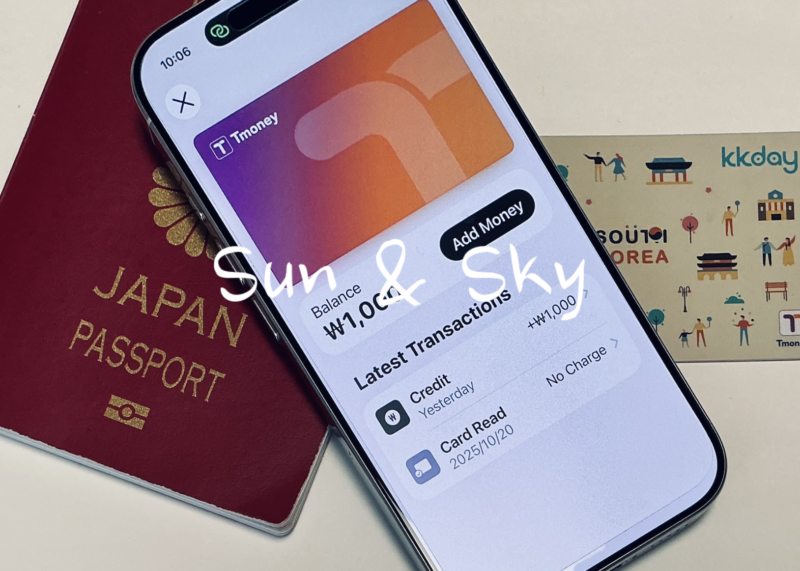
Paying: use a T-money card
The easiest way to pay is a T-money card. Tap in, tap out. I paid 4,350 won for the airport-to-airport ride in 2025. Blue-line fares are distance-based and they do change, so check the official AREX fare page.

(T2, taken in 2025)
With T-money, there is no deposit and no machine to find. You are able to purchase in KKday or KLOOK, and pickup at airports.
>>KKday South Korea LG U+ 4G/5G SIM Card (Includes T-Money & Voice Calls) | Airport Pickup
>>KLOOK T-Money Card
Finding the train: Incheon is easy, Gimpo is not
At Incheon, both T1 and T2 terminals are straightforward, the signs are clear, and I did not get lost at either terminal on any of my three trips.
Gimpo is a different story. Gimpo Airport Station has four basement levels. Trains to Incheon leave from B4, the deepest one, and the ticket gates are up on B1. From the gates to the terminals there is a long underground corridor with moving walkways; AREX’s own station guide lists the walk to the terminal at 10 to 15 minutes, and with a suitcase I would trust that number rather than hope for less. For the international terminal, follow the Exit 2 direction after the gates.
In 2019 I felt that Seoul Station was a maze. In 2025 I found that Gimpo Airport Station carries the same spirit. I can only speak for these two stations, but my advice at both is the same: add walking time to whatever the timetable tells you.
Is a same-day connection at Incheon or Gimpo enough time? What three transfers taught me
I have not tried to complete an Incheon-Gimpo connection inside a single travel day. All three times I built a route through here, I chose to break the trip with a hotel night rather than gamble on a tight same-day connection, and after seeing what a smooth transfer actually looks like with priority handling, I would make the same choice again.
Incheon to Gimpo, first trip: priority tags on my luggage did not stop Incheon Terminal 2’s baggage claim from being slow, and my inbound flight was also running late. The itinerary had an estimated 4-hour margin between landing and my Gimpo departure, and even on paper that felt too tight to trust. I booked a room at Lotte City Hotel Gimpo Airport in advance instead of counting on making the same-day connection. That turned out to be the right call: by the time I reached Gimpo Airport Station, I had only 60 minutes left before my flight’s scheduled departure. The walk from the AREX platform to the international terminal alone takes 10 to 15 minutes, before check-in, security, and immigration. If I had been counting on making that connection, I would not have made it.
Incheon to Gimpo, second trip: same pattern, different terminal. This time it was Incheon Terminal 1, baggage claim was slow again, and the inbound flight was late again. The estimated margin was about 3.5 hours, and after the first trip, that was an easy decision: Lotte City Hotel Gimpo Airport again, without debating it.
Gimpo to Incheon (a separate 2025 trip): this direction went closer to plan. With priority handling, immigration and baggage claim together took about 60 minutes, and landing to arrival at Incheon Terminal 1 took around 90 minutes in total. That included one delay of my own making: not every blue-line train heading toward the airport actually runs all the way there. Some end early, at a station such as Geomam, even during ordinary daytime hours and not only late at night. I did not check the destination shown on the platform, ended up on one of these, and waited on a cold platform for the next through train. Even with that mistake, the 90 minutes held up, but only because everything else about the transfer went smoothly. I stayed at Darakhyu at Terminal 1 that night and flew out of Incheon the next morning.
None of these numbers is a promise about how much time you have to spare. They are what happened on three separate connections, two Incheon-to-Gimpo and one Gimpo-to-Incheon, all with priority baggage handling and no major queues beyond the ones described. Bags are not moved between Incheon and Gimpo automatically, even on a single ticket booked as one itinerary; you collect your own bags and check in again yourself at the other end. If your connection estimate lands anywhere near 3.5 to 4 hours, building a hotel night into either side removes the guesswork rather than testing it.
If your Gimpo transfer includes an overnight stay, I stayed at Lotte City Hotel Gimpo Airport, which is directly connected to the terminals. My full review is here: Lotte City Hotel Gimpo Airport review.
The orange train: nonstop between Seoul Station and Incheon (in 2019)
In September 2019 I took the orange Express from Seoul Station to Incheon Terminal 1. The train itself was the easy part: all seats reserved, car and seat numbers printed on the ticket, and the car was almost empty. The ride is not short, but it is comfortable. As of July 2026, the nonstop ride takes 43 minutes to Terminal 1 and 51 minutes to Terminal 2, and the counter fare is 13,000 won, with online tickets around 11,400 to 11,600 won (official site; times also listed by the Korea Tourism Organization).
You are not able to ride the Orange with T-Money.
You are also able to purchase in KKday or KLOOK.
Seoul Station is a maze
Getting to the train was harder than riding it.
It was my first time at Seoul Station, and Japanese travelers had warned me about it, so I went much earlier than I needed to, and they were right. The Korean friends I have made over the years tend to run more relaxed about timing than the schedule suggests; that is just the handful of people I happen to know, not a claim about a whole country, but Seoul Station is not the place to test that theory before an international flight.
Seoul Station is old and large, with the regular railway, KTX, several subway lines, and AREX stacked together. From the Line 4 subway platform to the AREX area took me more than 30 minutes with check-in luggage. Along the way, passengers kept quietly pointing me in the right direction; it was always women, and I am still grateful to them. I try to do the same for visitors to my own country.
My advice has not changed since 2019: arrive at Seoul Station much earlier than you think you need.
In-town check-in at Seoul Station
Seoul Station has a City Airport Terminal where passengers of certain airlines can check in and drop bags before boarding the train. In 2019 my Jin Air, an LCC flight qualified.

I dropped my suitcase, passed an immigration pre-check next to the A’REX gates, and the whole process took under 10 minutes because there was almost no line. At Incheon, this gave me access to a priority lane at security. Finding that lane took some looking, but skipping the main queue was worth it. The list of participating airlines and the check-in deadlines change, so confirm on the official page before you count on this service.
A’Rex, Orange
All the seats are reserved.
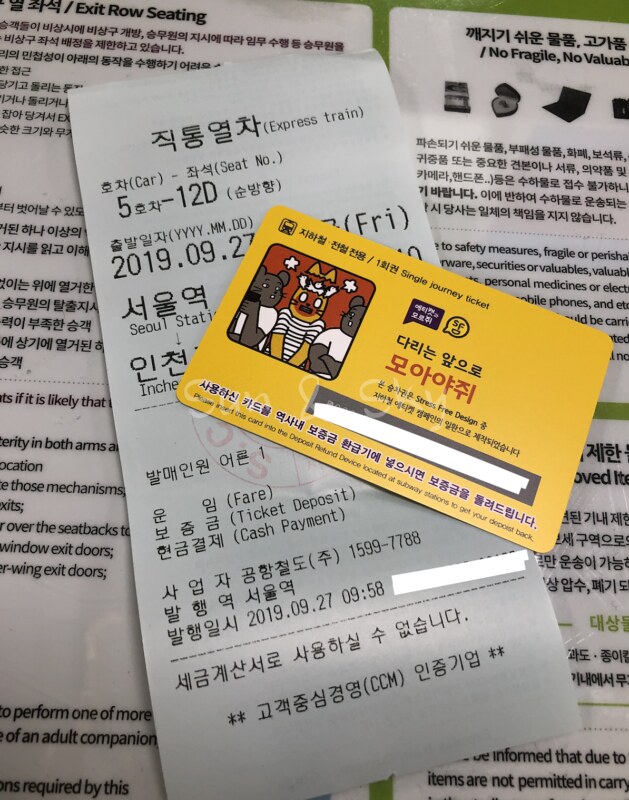
There are car number and seat number.
Indeed the A’Rex itself was almost empty.
It is a non-stop shuttle between Seoul Station and Incheon Airport. It is not short, but comfortable.

Do not forget the deposit
When in Rome, do ad Roman do.
The 500-won deposit
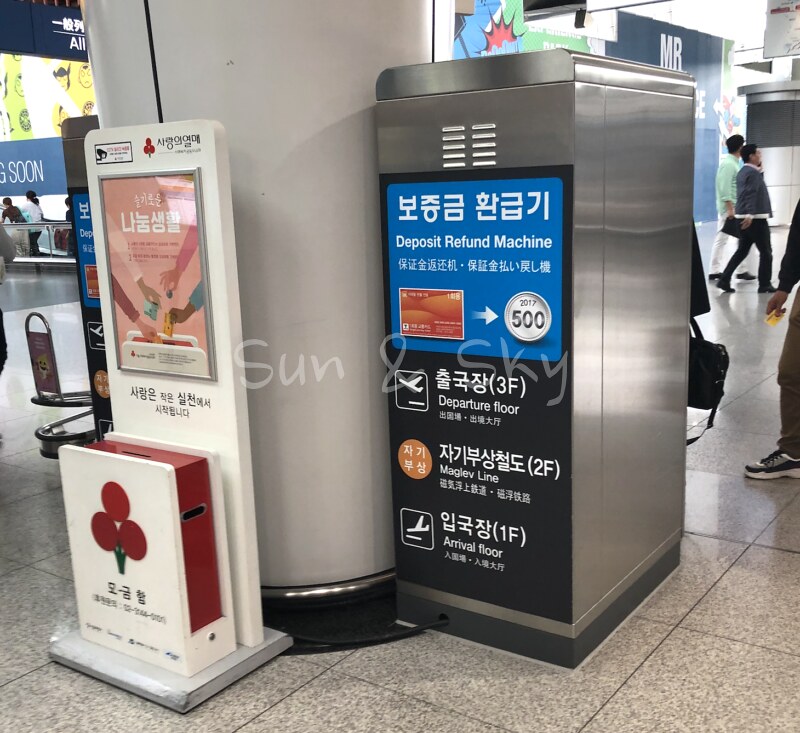
One small thing puzzled me in 2019: even with a ticket prepaid online, my paper ticket carried a 500-won deposit, refunded by a small machine at the destination station. It was less than one US dollar, but nobody explains what it is for, and finding the refund machine with luggage is one more task at the end of a trip. Recent guides say online Express tickets are now QR codes with no deposit, but I have not used one myself since 2019, so I cannot confirm that. What I can confirm is that the blue train with T-money involves no deposit at all.
Priority to security check at the airport
In Seoul Station, I had done with the passport control. So, I do not need to be on the long line of security check and passport control in Incheon Airport.
Incheon Terminal 1 is also not great about pointing you in the right direction, and I had to hunt for the priority lane myself. Some of the chaos that day may have come from a K-pop boy band (“Idoles”, as far as I could tell) passing through — I was nearly swept along by their fans. I completely agree with keeping non-passengers out of the departure hall.
Is airport bus convenient?
What about the airport bus?
In 2019 I also used the airport limousine bus, from Incheon into central Seoul.
The ride was estimated at 80 to 90 minutes; it took more than 120. You do not have to walk with your luggage, and if you travel with children or elderly family, sleeping in a seat is a real advantage. But Seoul traffic is Seoul traffic. Buses also run between Incheon and Gimpo, and after three train transfers I see no reason to bet a flight connection on road conditions. The rail timetable does not care about rush hour.